

Ph.D. in Cognitive Warfare and Strategic Influence
In today’s rapidly evolving threat landscape, security is no longer confined to physical domains. Information, perception, and human cognition have become strategic battlegrounds.
The Ph.D. in Cognitive Warfare and Strategic Influence is a pioneering doctoral program designed to prepare a new generation of experts capable of understanding, shaping, and defending against cognitive and influence operations in complex geopolitical environments.
This program positions you at the forefront of next-generation security, where artificial intelligence, behavioral science, and strategic thinking converge.
Why This Program
– Focus on modern security threats beyond traditional warfare
– Strong emphasis on real-world intelligence and policy application
– Integration of AI, cybersecurity, and behavioral sciences
– Direct alignment with UAE national security and innovation strategies
– Opportunities for international research collaboration and impact
What You Will Learn
– Cognitive warfare theory and influence operations
– AI-driven behavioral analytics
– Disinformation and hybrid warfare
– Cyber-psychology and digital influence
– Ethics, law, and policy in cognitive security
Program Goals
- Develop advanced expertise in cognitive warfare and strategic influence, enabling graduates to conduct high-quality, impactful, and interdisciplinary research.
- Equip graduates with analytical, technological, and strategic capabilities to address complex challenges related to information operations, behavioral influence, and cognitive security.
- Prepare graduates to become thought leaders and strategic advisors in academia, government, defense, and international organizations.
- Support the UAE’s strategic priorities in national security, digital transformation, artificial intelligence, and cognitive resilience, contributing to a knowledge-based and globally competitive economy.
- Promote interdisciplinary innovation through the integration of artificial intelligence, behavioral sciences, and strategic studies in research and practice.
- Foster international collaboration and engagement, enabling candidates to contribute to and benefit from global research networks and diverse academic environments.
Career Opportunities
The Ph.D. in Cognitive Warfare and Strategic Influence program is ideal for candidates seeking to build careers in:
- Government ministries (e.g., defense, foreign affairs, interior)
- Multilateral organizations (e.g., United Nations, Arab League, African Union)
- Regional security alliances (e.g., GCC, NATO)
- Humanitarian and development agencies
- Academia and higher education institutions
Why Choose AUE
- Strategic Location in Dubai’s International Academic City—hub for innovation, diplomacy, and global engagement.
- Research Infrastructure including access to global databases, policy repositories, and simulation labs.
- Interdisciplinary Approach that combines politics, economics, law, technology, and development.
- Tailored Support from admission to graduation, including personalized supervision and career guidance.
- Diverse Student Body with peers from across the Middle East, Africa, Asia, and beyond.
ADMISSION REQUIREMENTS
-
- Academic Qualification Hold a Master’s degree in a relevant discipline from an accredited higher education institution, with a minimum cumulative grade point average (CGPA) of 3.0 on a 4.0 scale, or its equivalent.
- English Language ProficiencyDemonstrate proficiency in English by submitting a valid test score meeting one of the following minimum requirements:
- IELTS: Overall band score of 6.5
- TOEFL iBT: Minimum score of 91
Exceptions to English Language Proficiency- A native speaker of English who has completed his/her Master's degree in an English-medium institution and in a country where English is the official or de facto national language; or
- An applicant with a Master's degree in an English-medium program who can provide evidence of acquiring a minimum IELTS Academic score of 6.0 or its equivalent, at the time of admission to his/her Master's program.
- Research Proposal Submission Submit a research proposal of 1,500–2,000 words clearly outlining the proposed research topic, objectives, preliminary literature context, and intended methodology.
- Letters of Recommendation Provide two letters of recommendation from academic and/or professional referees who can attest to the applicant’s academic ability and research potential.
- Admissions Interview Successfully complete an admissions interview conducted by the Doctoral Admissions Committee. Final recommendation must include a written justification from the Dean for final approval from the Graduate Studies Steering Committee.
- Professional Experience Relevant professional experience in the field shall be considered an added merit during the admissions assessment process.
- A Master’s degree in Security, Global Studies, Warfare or a related field from an accredited institution, with a minimum GPA of 3.0 on a 4.0 scale.
- A valid English proficiency score:
- IELTS: Minimum 6.5
- TOEFL iBT: Minimum 79
- Submission of a research proposal (1,500–2,000 words) outlining the candidate’s intended research area.
- Two letters of recommendation (academic or professional).
- Successful performance in an admissions interview conducted by the doctoral committee.
ACCREDITATION
The PhDSGS program is accredited by:
- The Commission for Academic Accreditation (CAA) – UAE’s national regulatory body.
- This program is Pending SACSCOC approval.
These accreditations ensure that your PhD from AUE is recognized globally—whether you pursue a career in academia, international organizations, or high-level policy environments.
PROGRAM STRUCTURE
Course Category
Total Number of Courses
Total Number of Credit Hours
Core Courses
9
30
Elective Courses
1
3
Comprehensive Exam
1
0
Dissertation / Applied Research Project
1
30
Total
63 Credit Hours
PROGRAM courses
CORE COURSES
9 COURSES | 30 CREDIT HOURS
ELECTIVE COURSES
1 COURSES | 3 CREDIT HOURS
Comprehensive Exam
0 CREDIT HOURS
Students will complete written and oral examinations to demonstrate their mastery of core and elective coursework, as well as their readiness for dissertation research. Students must pass the comprehensive exam before starting their thesis. If students fail the comprehensive exam, they will have one opportunity to retake it after one month.
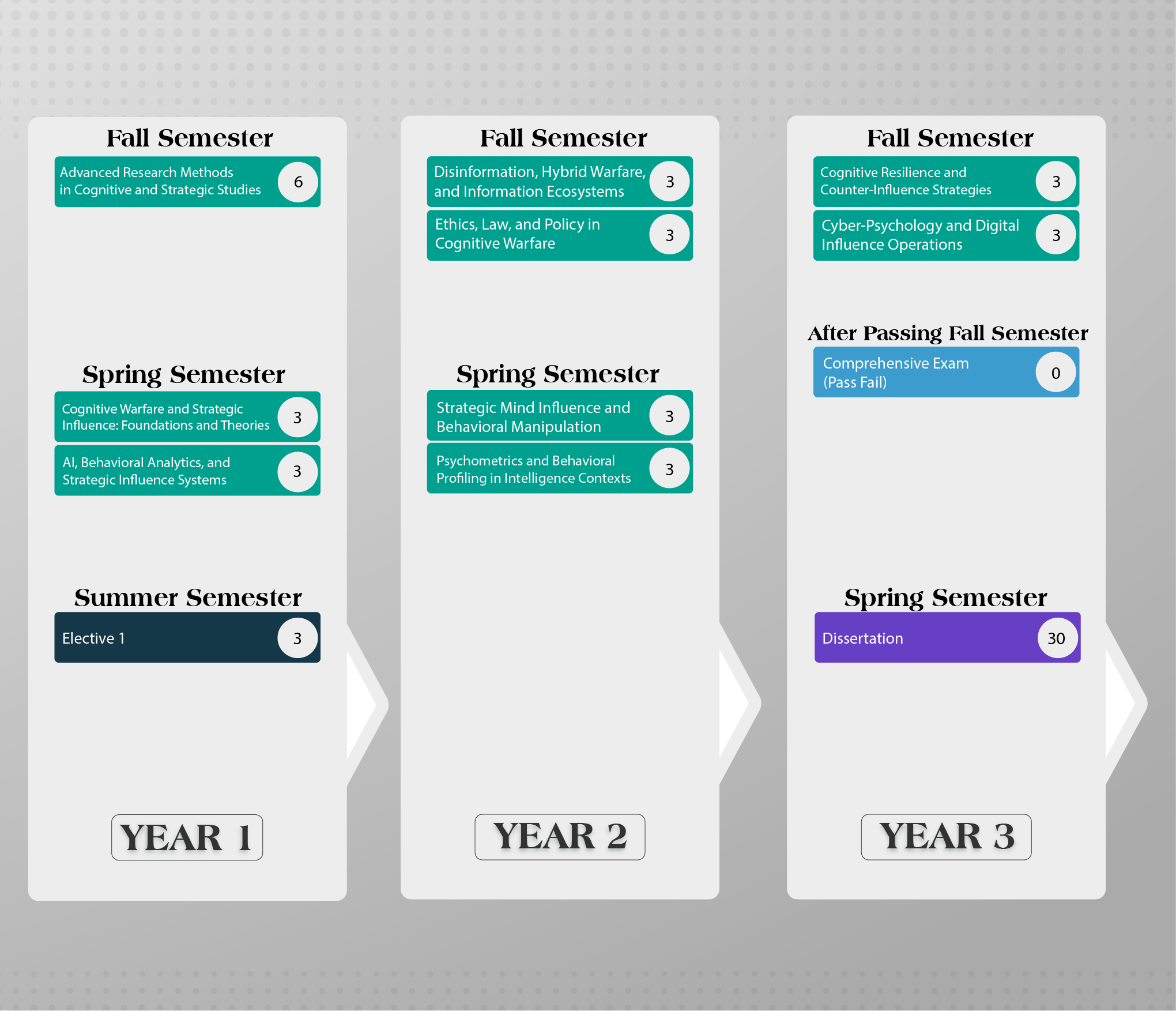
RECOMMENDED STUDY PLAN
Program Director

Prof. Dusko Tomic
Professor / Program Director of the Ph.D. in Security and Global Studies