

About Concentration
Program Learning Outcomes
Student Employability
About Concentration
The Digital Marketing and Brand Communication (DMBC) concentration prepares students to lead in a digital-first communication environment where brands are built through strategy, data, and creative engagement. It reflects the realities of contemporary marketing, where audience interaction, platform dynamics, and brand identity are closely interconnected.
Students learn to design and implement communication strategies that respond to evolving market needs. From developing brand positioning to executing digital campaigns, the program emphasizes the ability to align message, medium, and audience. Graduates are trained to think both strategically and creatively—building coherent brand narratives while adapting to rapidly changing digital ecosystems.
DMBC develops three core areas of expertise. First, students gain practical skills in producing content across platforms, including social media, web, and emerging digital formats, ensuring consistency with brand identity and audience expectations. Second, they learn to use research methods, media analytics, and consumer insights to guide decision-making and improve campaign performance. Third, they cultivate innovation and critical thinking, working collaboratively to design solutions to complex marketing and communication challenges.
Ethics and responsibility are central to the program. Students engage with issues of transparency, cultural relevance, and professional integrity in digital communication, preparing them to operate responsibly in both local and global contexts. The program also emphasizes experiential learning through student-faculty research, industry projects, and community engagement initiatives, allowing students to apply their knowledge in real-world contexts.
Graduates leave with the ability to create communication that is not only strategic and data-driven but also meaningful—content that connects with audiences, shapes perceptions, and builds lasting brand relationships. This emphasis on purposeful communication defines the program’s approach to digital marketing and storytelling. As marketing leader Seth Godin notes: “Marketing is no longer about the stuff that you make, but about the stories you tell.”
Program Learning Outcomes
Program Learning Outcomes
- PLO 1: Apply digital media, integrated marketing communication, public relations, and broadcasting theories to design and implement brand communication strategies that respond to diverse organizational and societal needs in each concentration.
- PLO 2: Design and produce multimedia content, including text, audio, video, and interactive formats that aligns with brand identity, audience expectations, and professional production standards across digital and traditional platforms.
- PLO 3: Use communication research methods, media analytics, and consumer insights to evaluate message effectiveness and optimize campaigns across media channels.
- PLO 4: Integrate creativity, innovation, and critical thinking in the development of communication projects, while demonstrating effective teamwork in collaborative media environments.
- PLO 5: Apply ethical principles, cultural sensitivity, and professional norms in producing and disseminating media content within global and local contexts.
- PLO 6: Engage in student-faculty research collaborations, applied projects with industry partners, and community-focused communication initiatives that demonstrate the social responsibility of their particular concentration.
Student Employability
Student Employability
Graduates of the Bachelor of Arts in Strategic Media Communication are prepared for a media environment shaped by digital convergence, data-driven decision-making, and cross-platform storytelling. The program develops practical and transferable skills aligned with current industry expectations across media, communication, and marketing sectors. Through applied learning, internships, and industry engagement, students gain hands-on experience that supports a smooth transition into the workforce and strengthens career readiness.
Graduates will develop the ability to:
- Design and implement integrated communication strategies across digital and traditional platforms
- Produce multimedia content (text, audio, video, and interactive formats) to professional standards
- Apply digital storytelling techniques and adapt content for diverse audiences and channels
- Use research methods, media analytics, and consumer insights to evaluate and optimize campaigns
- Manage social media platforms, digital campaigns, and brand communication initiatives
- Integrate creativity and critical thinking in solving communication challenges
- Work effectively in collaborative, team-based media environments
- Apply ethical principles, cultural awareness, and professional standards in media practice
- Engage with real-world clients through internships, applied projects, and industry partnerships
Career and employability pathways Include:
- Digital Media Producer
- Public Relations Specialist
- Social Media Manager
- Brand Strategist
- Digital Marketing Executive
- Content Creator
- Corporate Communication Officer
- Advertising and Media Planner
The combination of technical skills, strategic thinking, and professional practice positions graduates for entry-level roles and long-term career progression in the media and communication industries.
ADMISSION REQUIREMENTS
For further information, please click here
GRADUATION REQUIREMENTS
For undergraduate degree completion, undergraduate students must satisfy the following requirements:
- Earn a minimum CGPA of 2.00 on a scale of 4.00.
- Successfully complete all courses as described in the study plan.
- The Degree Completion requirements must be met within the timeframe of the program.
- Transfer students must successfully earn a minimum of 50% of the course credits for the program at AUE.
ACCREDITATION
The American University in the Emirates is licensed by the UAE Ministry of Education – Commission for Academic Accreditation | caa.ae
Preparatory Courses
Prior to their enrollment in the program, students applying for Bachelor of Arts in Media and Mass Communication must sit for the placement test related to the program, failure to successfully passing the placement test, they are required to enroll in the following courses:
| # | Course Code | Course | Credit Hours | Exemption Condition |
| 1 | CIT 90 | Computer Preparatory | 0 | Passing the Placement Test |
| 2 | ENG 99 | Academic Writing (*) | 0 | Passing the Placement Test |
PROGRAM STRUCTURE
Course Category
Total Number of Courses
Total Number of Credit Hours
General Education Courses
12
36
Core Courses
18
54
Concentration Courses
8
24
Concentration Elective Pool
4
12
Total
42 Courses
126 Credit Hours
PROGRAM MODULES & DESCRIPTIONS
General Education Courses
Core Courses
Concentration Courses
Concentration Elective Pool Courses
General Education Courses
GENERAL EDUCATION COURSES
12 COURSES | 36 CREDIT HOURS
A: University Core Requirements
The purpose of this course is to facilitate the process of transition into the new academic and cultural environment for the new students enrolled in the AUE. Furthermore, it aims to promote their confidence so that they could succeed and meet their academic requirements. The course assimilates academic content with interactive in-class activities to ensure understanding of curricular options and begin to develop a future career plan through self-reflection.
Innovation is the engine of opportunity and, acting as a catalyst, this course is intended to ignite an interest in innovation and inspire entrepreneurial action. At the core of innovation and entrepreneurship is a commitment to experiential learning that will encourage students to engage in critical thinking, creative problem-solving while also equipping them with the soft skills needed in their pursuit of academic and professional endeavors. Students will discuss the relevance and role of innovation and entrepreneurship in work and life situations; determine opportunities for creative disruption and design a strategy for its implementation; develop a practical understanding of innovation through thoughtful debate and exercises, and demonstrate critical thinking and individual insight with a personal mastery portfolio.
B: Languages and Communication Studies
This course focuses on improving students’ basic critical reading and writing skills in English so that they can successfully write free-error varied sentences and paragraphs. The course also focuses on contextualized mechanics instructions and sentence skills.
The intent of this course is two-fold. First, it introduces students with the basic research terminologies. Second, it familiarizes them with the process of research from choosing a topic to writing the proposal. Students will be immersed in hands on experience where they will be introduced to research concepts that will help them understand, interpret, and critique a scientific research. Contents to be covered include the language of research, types of research, elements of scientific research proposal, writing an academic research proposal using APA style, research ethics, crafting data collection instruments, and interpreting data.
This course is designed to enable students to analyze multiple texts in various fields of knowledge. In order to be able to distinguish between texts despite their difference of contents, it also enables student to simulate those texts in a correct way, and to transform the information into skill and behavior. And since writing is an integrated building process, and that the building is affected by its parts, therefore student needs models, linguistic laws, planning, cohesion and goals including: news and inquiries, demand and influence of the recipient.
This course is designed to enable the Arabic-speaking student with the necessary language skills, especially focusing on the steps of writing reports, official letters and systematic research. To achieve this, and to develop the student’s abilities to understand correctly what he reads and listens, and to gain the ability to write articles, reports, meeting minutes and recommendations of conferences and seminars in a sound manner, the course was concerned with training the student in basic writing skills; such as multiple spelling rules, punctuation marks, paragraph system, and essay writing progressively.
C: The Natural sciences or Mathematics
This course is designed to develop a good understanding of the fundamental concepts of mathematics. It also stresses crucial cognitive transferable skills such as the ability to think logically and concisely. Mastering this course will give students the confidence to go on and do further courses in mathematics and statistics.
D: The Social or Behavioral Sciences
This course will introduce the students to the key concepts of Political Science and its principal tools. The course will discuss the role of main political actors in the field of politics and their function.
This course introduces the science of Sociology. Students will examine Society, Institutions, and the relationships that make up a social context. The scientific methodology used to study social interactions, stratification, and other elements of sociological inquiry will be discussed to emphasize the core concept of sociology as a systematic study of societies and social structures
E: The Humanities or Arts
This course will introduce the students to the key concepts of philosophy and its principle tools. The course will discuss the schools of philosophical thought and will apply philosophical analysis to the topics of knowledge, religion, mind, freedom, responsibility, and ethics.
F: Islamic Studies
This course will expand students’ knowledge to enable them to understand the Islamic culture and its characteristics. It analyzes the sources of legislation in Islam. It offers a review of the history of Islam and how it is currently the fastest-growing religion in the world.
The course is designed to give an in-depth understanding of the Islamic civilization. It deals with the universal principles that went into the making of the Islamic civilization. It examines the basic ideas of Islamic civilization besides exploring their contemporary relevance and challenges. The course seeks to effectively address the notion of the ‘clash of civilizations.
G: UAE Studies
F: OTHER
Core Courses
CORE COURSES
18 COURSES | 54 CREDIT HOURS
This course is a fully developed introduction to the fundamentals of the theories that define the communication discipline and professions. This being journalism, public relations, multimedia productions, and s. Covering the main questions and theories emphasizing the emergence of mass communication in the UAE and the Gulf States (GCC) at large.
Social media are constantly changing the ways masses communicate with each other and the business. Students comprehend different types of social mediums, tactics, and how social media changed the way we interconnect and collaborate with the world, professionally and in personal lives. Students will be required to apply their insight about the subject by contributing on available social mediums and platforms through intuitive course projects. The course will investigate the connection amongst media and human conduct, and will examine how corporations are capitalizing through social mediums
This course will provide the students with a comprehensive overview of writing for the Mass Media. The students are expected to understand the basic principles of writing for the mass media.
A course designed for the student interested in developing speaking skills. Emphasis will be placed on organization, supporting material, delivery, and audience analysis. Further attention is given to the study of social relationships and the communication process.
Concentration Courses
CONCENTRATION COURSES
8 COURSES | 24 CREDIT HOURS
Digital Storytelling is a course that focuses on examining both traditional and new media. This includes oral storytelling, literature, museum exhibits, poetry, visual arts, architecture, hypertext fiction, Net Art, and finally, computer games. The students explore and develop their sense of visual narrative through key theories of visual narrative and look at a broad range of examples from within the integrated strategic communications to help consider how images and spaces can tell stories with or without accompanying words. Narrative perspectives of the maker, the audience, and visual form itself will be examined to design campaigns and promotional materials for changing attitudes and behaviors, as well as to promote products, ideas, and services for marketing.
Concentration Elective Pool Courses
Concentration Elective Pool Courses
4 COURSES | 12 CREDIT HOURS
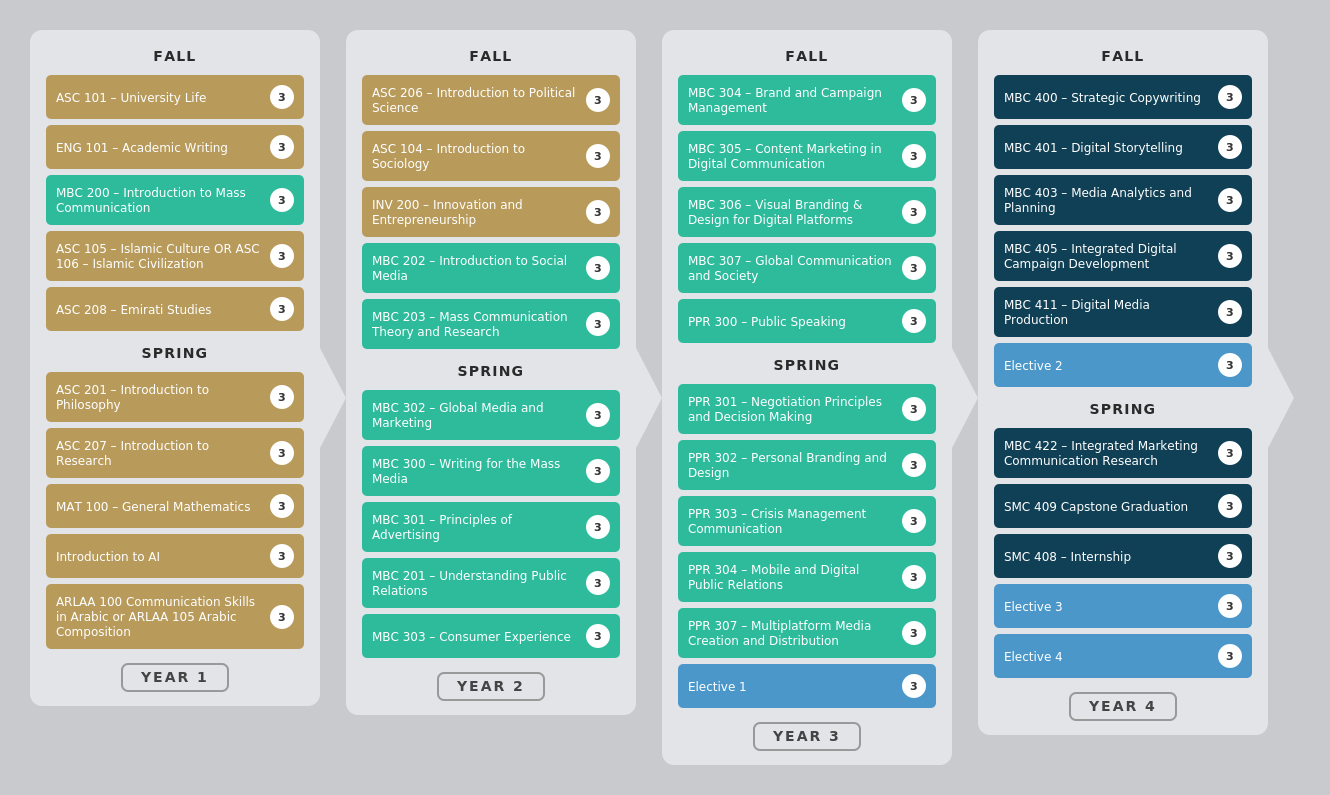
RECOMMENDED STUDY PLAN
ATTENDANCE
Student builds the schedule based on available offered courses in the registered semester
Weekday Morning Classes
THU – THUR | BETWEEN 9:00 AM – 4:00 PM
MON – WED | BETWEEN 9:00 AM – 4:00 PM
MON – WED | BETWEEN 9:00 AM – 4:00 PM
Weekday Evening Classes
TUE – THUR | BETWEEN 4:00 PM – 9:00 PM
MON – WED | BETWEEN 4:00 PM – 9:00 PM
MON – WED | BETWEEN 4:00 PM – 9:00 PM