

Bachelor of Arts in Security and Global Studies - International Relations
Overview
The International Relations (IR) concentration equips students with a deep understanding of the political, economic, and security dynamics that shape interactions among states, international organizations, non-state actors, and global institutions. Grounded within the interdisciplinary framework of Global Studies, this concentration provides students with the analytical tools to critically examine issues of diplomacy, conflict and cooperation, global governance, human rights, and transnational challenges such as climate change, migration, and cybersecurity.
Students pursuing this concentration will engage with both theoretical approaches and applied perspectives in international politics, learning how power, identity, culture, and interests influence decision-making in a complex, interconnected world. The curriculum combines courses in political science, security studies, history, economics, and law, ensuring a comprehensive view of international affairs.
In addition to developing strong research, communication, and policy-analysis skills, students will explore the role of their region, including the Middle East and the Gulf, within global politics. Through simulations, case studies, internships, and exposure to diverse epistemological perspectives, students bridge the gap between academic knowledge and real-world practice.
Graduates of the International Relations concentration will be well-prepared for careers in diplomacy, international organizations, government agencies, research institutions, NGOs, and the private sector, as well as for advanced graduate studies in international relations, political science, or related fields.
PLO1 Demonstrate a comprehensive understanding of key theories, frameworks, and concepts in political science, international relations, and security studies, including diplomacy, global governance, conflict resolution, and strategic affairs.
PLO2 Critically analyze global and regional political and security issues through multiple theoretical, cultural, and epistemological perspectives, recognizing the influence of diverse traditions, institutions, and practices.
PLO3 Independently design and conduct research projects using established methodologies in political science and security studies, applying evidence-based approaches to address contemporary challenges in international relations and security.
PLO4 Communicate complex political and security-related concepts clearly and effectively in written, oral, and digital formats across academic, professional, and multicultural contexts, while upholding ethical standards, cultural sensitivity, and responsibility toward global justice and human rights.
PLO5 Assess the political, economic, and security dynamics of the UAE and the wider Arab and Gulf regions within the global system, evaluating their roles in diplomacy, development, and international security.
PLO6 Apply theoretical concentration-specific knowledge to practical settings through case studies, simulations, projects, or internships, bridging academic learning with real-world practices in diplomacy, geopolitics, conflict management, and security studies.
PLO 7 To develop critical, ethical, and globally minded thinkers capable of analyzing and addressing complex geopolitical challenges.
ADMISSION REQUIREMENTS
For further information, please click here
GRADUATION REQUIREMENTS
For undergraduate degree completion, undergraduate students must satisfy the following requirements:
- Earn a minimum CGPA of 2.00 on a scale of 4.00.
- Successfully complete all courses as described in the study plan.
- The Degree Completion requirements must be met within the timeframe of the program.
- Transfer students must successfully earn a minimum of 50% of the course credits for the program at AUE.
ACCREDITATION
The American University in the Emirates is licensed by the UAE Ministry of Education – Commission for Academic Accreditation | caa.ae
This program is Pending SACSCOC approval.
Preparatory Courses
Prior to their enrollment in the program, students applying for Bachelor of Arts in Security and Strategic Studies must sit for the placement test related to the program, failure to successfully passing the placement test, they are required to enroll in the following courses:
| # | Course Code | Course | Credit Hours | Exemption Condition |
| 1 | CIT 90 | Computer Preparatory | 0 | Passing the Placement Test |
| 2 | ENG 99 | Academic Writing (*) | 0 | Passing the Placement Test |
PROGRAM STRUCTURE
Course Category
Total Number of Courses
Total Number of Credit Hours
General Education Courses
12
36
Core Courses
19
57
Concentration Courses
5
15
Elective Courses
4
12
Total
40 Courses
120 Credit Hours
PROGRAM MODULES & DESCRIPTIONS
GENERAL EDUCATION COURSES
12 COURSES | 36 CREDIT HOURS
A: University Core Requirements
The purpose of this course is to facilitate the process of transition into the new academic and cultural environment for the new students enrolled in the AUE. Furthermore, it aims to promote their confidence so that they could succeed and meet their academic requirements. The course assimilates academic content with interactive in-class activities to ensure understanding of curricular options and begin to develop a future career plan through self-reflection.
Innovation is the engine of opportunity and, acting as a catalyst, this course is intended to ignite an interest in innovation and inspire entrepreneurial action. At the core of innovation and entrepreneurship is a commitment to experiential learning that will encourage students to engage in critical thinking, creative problem-solving while also equipping them with the soft skills needed in their pursuit of academic and professional endeavors. Students will discuss the relevance and role of innovation and entrepreneurship in work and life situations; determine opportunities for creative disruption and design a strategy for its implementation; develop a practical understanding of innovation through thoughtful debate and exercises, and demonstrate critical thinking and individual insight with a personal mastery portfolio.
B: Languages and Communication Studies
This course provides students with advanced writing skills in English so that they can successfully pursue their studies in various academic specializations. It helps students to develop, improve, and upgrade their writing and structure skills, and it also acquaints students with technical writing, research papers, and essays since brief research methods are applied in student projects and assignments.
Students must take one of the following Arabic Language courses:
C: The Natural sciences or Mathematics
D: The Social or Behavioral Sciences
This course will introduce the students to the key concepts of Political Science and its principal tools. The course will discuss the role of main political actors in the field of politics and their function.
This course will provide the students with a comprehensive overview of geography. Emphasis is on concepts that are necessary to understand global, regional, and local issues. This course also includes topics on both human and physical geography.
E: The Humanities or Arts
The student selects 3 credit hours (1 course) from the list below:
This course provides an overview of World / General History. The course will conclude with discussions about perspectives on World History. It surveys the history of humankind from 250CE till 1990 CE. In addition, interregional, comparative, cross-cultural, transnational, and historiographical topics will be considered. The objective of the course is to explore the roots of contemporary globalization and to develop historical thinking and writing.
This course provides an overview of Middle-Eastern History, including the sources of Middle Eastern History. The course will conclude with discussions about perspectives on Middle-Eastern History.
F: Islamic Studies
The student selects 3 credit hours (1 course) from the list below
G: UAE Studies
CORE COURSES
19 COURSES | 57 CREDIT HOURS
Research is one of the most crucial objectives within a BA Program. Getting to accustomed and developing on conducting a research, firstly in social sciences, specifically in Strategic topics in the world, is the main objective of this program and course. Conducting the research and especially orchestrating a social survey, problem of objectivity in strategic research, cultivating a specific formula on research problems and most importantly propound a right hypothesis on a deep subject are the assets of this course. To ensure and develop above mentioned processes and steps, scanning current articles, books and different studies in a specific area and pursuing selective reading techniques are cardinal elements to be studied. Preparing extended outline in accordance with hypothesis assembled in Security Studies, extending and transformation techniques, data collection, and research writings are the steps which will be learnt in this course. Some research topics are included into study such as security history, strategic geography, modern phenomena of peacemaking and peacekeeping, disarmament, counterinsurgency, important military strategists, types of strategies, effect of military and industrial complexes on the conflicts.
This course examines the key themes in IR: state and non-state actors, international norms, international law, international institutions, international theory and international system in a Globalized world The “Four Cs” (confrontation, compromise, co-operation and conflict) will be analyzed in depth. Last but not least, this course will focus on international security – in particular, the major threats of the 21st century
This course introduces a sub-field of political science known as Comparative Politics. It is one of the four traditional subfields of political science. Simply put, this is the study of political relationships and processes within particular countries (as opposed to the relations between countries), using the theoretical and empirical knowledge gained from comparative analysis. It differs from international relations for two reasons: in its focus on individual countries and regions, and its comparison across units (national and subnational actors) and substantive topics.
This course will help the students develop and understand various schools of thoughts of strategic studies. Furthermore, it will bridge the gap between theory and practice of strategic studies through the study of different works by classical and contemporary experts of this field. The course will help the students understand various themes of strategic studies to develop strategic thinking. Students in this course will learn how to create a balance between mindboggling theories and their applications.
This course is an introduction to international law, generally understood as the set of rules binding the international conduct of Nation-states actors and non-state actors. It will identify public international law, its sources, jurisdictions and states’ rights and obligations. Special topics to be addressed will include law of the sea, international criminal law, environmental law, human rights, and humanitarian international law. In addition, this course will provide a conceptual framework for the analysis of international law, contemporary debates and future trends.
The link between International security and environmental politics is centuries old. Increased pace and frequency of conquests and annexations, supported by mechanized and well developed equipment’s (an outcome of industrial revolution), were responsible for making the relation more explicit. This basic fact apart, throughout human history, we see a trend of ignorance towards environmental issues as greater importance always remained associated with apparatus and procedures which were considered a pre-requisite for ensuring security. These problems finally caught human attention and focus in the mid twentieth century. Since then a vast discourse has emerged to solve environmental problems by attempting to reduce the conflict between environment and International security endeavors. The main objective of designing this course is to make students familiar with this intricate web existing between security and environment. The particular discourse introduced in this subject is based primarily on liberal and feminist approaches towards International Relations as well as International Security; the approach similar to that held by Peace studies.
The course is a third-year level course for the Bachelor of Security and Strategic Studies. The course examines and analyses, through the scope of geography and political science combined, international and strategic affairs. Its scope provides an emphasis on political geography, international relations, strategic and security affairs and elements of international law when applicable in international affairs. Students will be introduced to elements of international affairs of the 20th and the 21st century, through the comprehension and utilization of maps and showcase the importance of natural resources and how pivotal role these play in international affairs seen as national, regional or international interests. Students are expected to approach international issues in way which can be define pragmatic in nature, as these vary from strategically led traditional approaches of international relations.
The course is designed to provide the students with deeper insight and perspectives towards national security and the arms race in the era of globalization. After the WWII, the dominant actors in the world politics have spent major portion of their national budget pursuing missile defense system, transnational threats, proxy wars, and star wars to shield against the threat of nuclear attacks, thus, provoking new arms races among nations and states. The emergence of 21st century is experiencing the most critical concerns of national security, which reflects the balance of power politics and the global arm race. The rapid changes emanating from the susceptibility of the transnational threats observed after post 9/11 symptoms demands more dynamic thought process to examine pure military expeditions have resulted in further alienation and paralysis of statehood theory and to some extent the democratic apparatus system. The course looks more deeply into the national security, statecraft, emergence of faith based ideological aspects, conflict resolution and peacemaking. The present trends on the arms races has seen countries both developed and under developing to set their security strategies covering risk assessment, security analysis, and public policy to long-term strategic goals. The course will help students to understand responsibility of the governments to address these threats to national and international security. Students will learn basic terminologies and discusses strategic and policy debates about new forms of terrorism after the 9/11. The sessions are designed to stimulate interest and debate among the students, professionals, public and policy-makers, by providing solid facts and analysis. This also allows scientific, geopolitical, historical and strategic analysis of various components to critique the delusion of perfect national security.
The course is designed to provide the students with deeper insight and perspectives towards national security and the arms race in the era of globalization. After the WWII, the dominant actors in the world politics have spent major portion of their national budget pursuing missile defense system, transnational threats, proxy wars, and star wars to shield against the threat of nuclear attacks, thus, provoking new arms races among nations and states. The emergence of 21st century is experiencing the most critical concerns of national security, which reflects the balance of power politics and the global arm race. The rapid changes emanating from the susceptibility of the transnational threats observed after post 9/11 symptoms demands more dynamic thought process to examine pure military expeditions have resulted in further alienation and paralysis of statehood theory and to some extent the democratic apparatus system. The course looks more deeply into the national security, statecraft, emergence of faith based ideological aspects, conflict resolution and peacemaking. The present trends on the arms races has seen countries both developed and under developing to set their security strategies covering risk assessment, security analysis, and public policy to long-term strategic goals. The course will help students to understand responsibility of the governments to address these threats to national and international security. Students will learn basic terminologies and discusses strategic and policy debates about new forms of terrorism after the 9/11. The sessions are designed to stimulate interest and debate among the students, professionals, public and policy-makers, by providing solid facts and analysis. This also allows scientific, geopolitical, historical and strategic analysis of various components to critique the delusion of perfect national security.
The Special Topics in Global Studies’ is intended to showcase the diversified areas of teaching that has wide relevance in local, regional and global context. Special Topics on Security will also provide the necessary skills for students to identify and assess contemporary security situations, most of which may include events and problematics on crime, terrorism, criminality, public and private security, cybersecurity, asymmetric warfare and illegal trade.
International conflicts are traditionally associated with dispute of two or more nation-states (inter-state), but could be related to conflict within one country(intra-state), when one or more groups are fighting for specific cause that have international consequences. The course will analyze international conflicts, while examining strategies and tactic for conflict management and conflict resolution.
This course will expose students to the evolution of the International System in the 21st Century, focusing on the causes and processes of regional and global power rise and collapse. The course emphasizes the role of emerging international powers and the fundamental factors driving their rise in addition to the significance of crisis international law in the emergence of these new world powers. As a result of this course, students will be able to examine the various aspects of power in these states and analyze their central policies.
This Internship course offers students a substantial industry placement. The Internship course intends to provide students the opportunity to apply and develop their classroom and academic learning in the workplace environment related to their study discipline and chosen specialization prior to graduation. Students typically enroll in this course in their penultimate or final semester. Employers increasingly expect university graduates and their graduate employees to have gained practical and vocationally specific experience as part of an undergraduate degree program. They also expect graduates to behave with an accomplished professionalism and to have developed professional attitudes, skills and behaviors. Undergraduate students, likewise, wish to have the academic and practical skill set to be valued as a potential employee. Undergraduate students also seek knowledge about the various career possibilities and opportunities in security field. An internship allows current students to understand the relationship between their academic and career choices and build a personal portfolio to assist them to make their career ambitions become a reality.
CONCENTRATION COURSES
5 COURSES | 15 CREDIT HOURS
ELECTIVE COURSES
4 COURSES | 12 CREDIT HOURS
12 Credit Hours must be chosen from any other college/specialization in condition the prerequisites of the chosen courses are met.
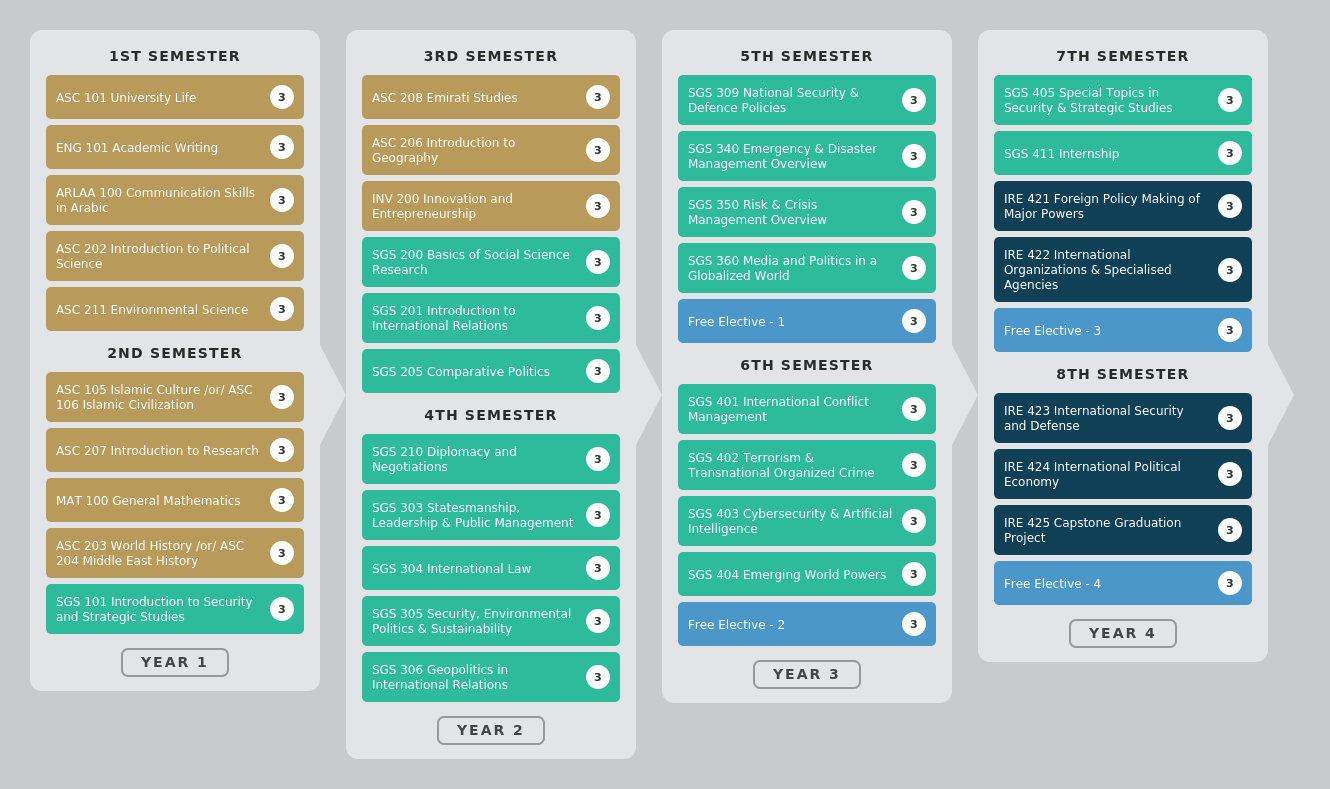
RECOMMENDED STUDY PLAN
ATTENDANCE
Weekday Morning Classes
MON – WED | BETWEEN 9:00 AM – 4:00 PM
Weekday Evening Classes
MON – WED | BETWEEN 4:00 PM – 9:00 PM